Nonwoven Fabrics Tensile Tester:
NWSP 110 vs ISO 9073
1. Nonwoven Tensile Testing Explained
Why is Nonwoven Tensile Testing So Important for Modern Nonwoven Products
The modern high-performance nonwoven products have become really demanding due to inaccurate tensile testing results, leading to product rejection, inconsistent durability performance, and compliance audit failures.
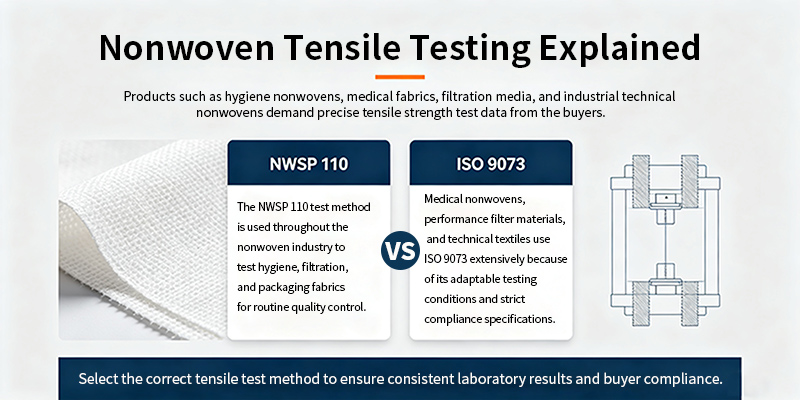
Products such as hygiene nonwovens, medical fabrics, filtration media, and industrial technical nonwovens demand precise tensile strength test data from the buyers.
The demanding modern nonwoven materials require really advanced tensile testing systems that maintain accuracy ±2% with a wide load capacity range.
Why Standards Are Important in Buying Decisions
The 2 main internationally accepted standard systems for determining the mechanical properties of nonwoven fabrics are NWSP 110 and ISO 9073. Although both of these test systems aim to evaluate tensile, tear and burst performance, some differences can lead to variations in measurement results, mainly due to differences in test speed, sample preparation, and the method of load measurement.
So for exporters and QA managers, it is very important to select the best and correct tensile test method to get results that are in line with other laboratories and that meet buyers’ requirements.
What Buyers Should Know Before Buying an Instrument
Before you buy an instrument for nonwoven tensile testing, you should first know the basics about tensile properties, the calculations of load and elongation, and the differences between the tests according to NWSP 110 and ISO 9073.
2. Tensile Properties in Nonwoven Fabrics
Definition of Tensile Strength for Nonwovens
Tensile Strength of Nonwovens: The tensile strength of nonwoven fabrics is defined by the maximum force a textile can withstand when stretched under a constant rate of extension until break, along with the corresponding elongation at break.
Tensile results can be expressed in several different units and, as a rule are measured and expressed in N/5cm, kN/m, or even elongation percentage (%). The tensile test is carried out at a constant extension speed, which can range from 10 mm/min up to 500 mm/min.
Modern laboratories are employing the Nonwoven Fabrics tensile tester for the tensile test of nonwoven fabrics. The results obtained are repeatable, and the accuracy of the results are ±2 % and better. This eliminates human error as far as possible.
Why Tensile Resistance Affects Product Performance
The incorrect tensile resistance negatively affects structural durability, application safety, and compliance performance.
The smart fabric tensile strength tester systems really improve the repeatability and also reduce the retesting costs by automatic speed adjustment, self-calibration.
3. Why Nonwoven Tensile Testing Really Matters
Performance of Hygiene and Medical Nonwovens
The highly accurate tensile testing is critical in hygiene and medical nonwovens because it determines how effectively the material maintains structural integrity during use.
Sufficient nonwoven tensile strength improves the anti-breakage performance, reduces failure risk, and also improves user safety. The lightweight hygiene nonwoven fabrics normally target balanced tensile values to ensure both strength and softness.
The Durability and Performance Optimization
The advanced testing helps manufacturers strike the right balance between tensile strength, softness, and production cost, which is really essential for export-quality nonwoven products.
The Industrial and Packaging Nonwoven Applications
Industrial nonwovens and packaging fabrics control the tensile resistance so that load-bearing capacity and processing performance are balanced. Excessively high tensile strength reduces fabric softness, while insufficient tensile strength causes structural failure during application.
The Tensile Strength vs Flexibility Balance
The modern tensile testing machine systems use automatic speed control to ensure highly consistent load measurement and improved testing consistency in coated and laminated nonwovens.
4. What Are The Differences Between NWSP 110 And ISO 9073?
NWSP 110 vs ISO 9073
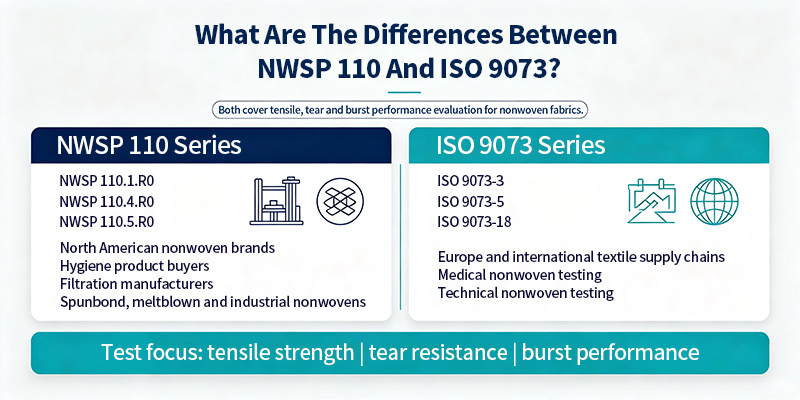
The test for the measurement of mechanical properties of nonwoven materials is covered by two main standard systems: NWSP 110 series and ISO 9073 series. Both cover tensile, tear and burst performance evaluation for nonwoven fabrics.
Test results are greatly affected by the differences in test speed and sample preparation rules. Modern test equipment can easily measure the tensile properties of nonwovens. You can program it to comply with international standards for testing this property.
The Overview of NWSP 110
Widely Used in North America
NWSP 110 series (including NWSP 110.1.R0, NWSP 110.4.R0, NWSP 110.5.R0) is widely used as a standard by North American nonwoven brands, hygiene product buyers, and filtration manufacturers. It is commonly applied to spunbond, meltblown, and also industrial nonwoven products.
NWSP 110.4.R0 (20)
Nonwovens Standard Procedure 110.4.R0‑2020: Tensile Strength & Elongation (Strip Method)
NWSP 110.5.R0 (20)
Nonwovens Standard Procedure 110.5.R0‑2020: Tear Resistance (Trapezoid Tear)
NWSP 110.1.R0 (20)
Nonwovens Standard Procedure 110.1.R0‑2020: Basis Weight (Mass per Unit Area)
The Standard Test Conditions
The standard NWSP 110.1 tensile test (strip method) is conducted at a constant speed of 300 mm/min, and results are expressed as force in terms of N/5cm or lbf/in. The series also covers trapezoid tear and ball burst test methods.
The Common Industrial Applications
The NWSP 110 test method is used throughout the nonwoven industry to test hygiene, filtration, and packaging fabrics for routine quality control.
The Overview of ISO 9073
The Internationally Preferred Standard
ISO 9073 series (including ISO 9073-3, ISO 9073-4, ISO 9073-5, ISO 9073-18) is widely used as a standard in Europe and the international textile supply chains, particularly for medical and technical nonwoven testing.
ISO 9073‑3
Textiles — Test methods for nonwovens — Part 3: Determination of tensile strength and elongation
ISO 9073‑4
Textiles — Test methods for nonwovens — Part 4: Determination of tear resistance
ISO 9073‑5
Textiles — Test methods for nonwovens — Part 5: Determination of ball‑burst strength
The Flexible Test Settings
ISO 9073 provides us with multiple speed options, with 100 mm/min being the most commonly used for strip tensile test. This also gives better flexibility for the lightweight and modern performance nonwovens.
The Technical Nonwoven Application
Medical nonwovens, performance filter materials, and technical textiles use ISO 9073 extensively because of its adaptable testing conditions and strict compliance specifications.
5. How to Choose a Nonwoven Tensile Tester
Tensile Tester for Nonwoven Fabrics
A tensile tester for nonwoven fabrics mainly depends on the lab workload, compliance requirements, and long-term performance.
The high-volume QA labs prefer the automatic systems because they improve the repeatability during tensile testing and also reduce dependency on the operator.
The Manual vs The Automatic Testers
Universal Tensile Strength Tester for nonwovens automatically performs the speed control, load measurement, and also real-time reporting, while the manual systems require frequent adjustments. The automatic systems improve testing speed and accuracy.
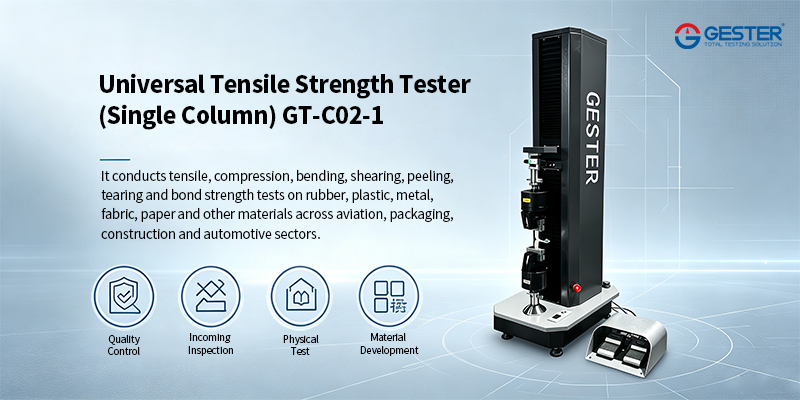
GESTER universal tensile strength tester is designed to conduct tensile, compression, bending, shearing, bonding strength, peeling, tearing and other tests for rubber, plastic, leather, metal, nylon thread, yarn, fabric, paper, aviation components, packaging materials, construction materials, petrochemical products, electrical components, automotive parts and other materials. It serves as basic equipment for quality control, incoming inspection, physical testing, mechanics research and material development.
Our fabric tensile tester adopts AC servo drive system, reducer, synchronous pulley, and TBI precision ball screw components, so the instrument beam moves smoothly with low noise and high extension precision.
This fabric tensile strength tester adopts aluminum column shell, with high-temperature curing injection treatment on the machine surface that will never fade.
Maintaining Stable Speed and Load Accuracy
The stable test speed and load accuracy is really crucial for NWSP 110 and also ISO 9073 compliance; the modern systems maintain ±2% accuracy.
This Nonwoven Fabrics tensile tester adopts many kinds of protection measures:
- Beam’s limit cams protecting device
- Clamp touch avoid protecting device
- Software protection for displacement and load
- Sensor overload protection
- Sample load software protection
- Overcurrent & overvoltage protection
It carries out real-time supervision of main parts, making the machine safer and more reliable during operation.
The Interchangeable Fixtures and Clamps
The highly advanced Universal Tensile Strength Tester supports multiple fixtures for the tensile, tear, burst and peeling tests, covering various nonwoven and other material structures.
Contact Us for a Free Demo or Consultation
For more information on nonwoven testing methods, standards, and Nonwoven Fabrics testing machines, contact us:
Tel : +86-595-28886108
Email : marketing@gester-instruments.com


 English